
LAKOTA WISDOM FOR THESE TIMES BY TONY TEN FINGERS (WANBLI NATA'U)
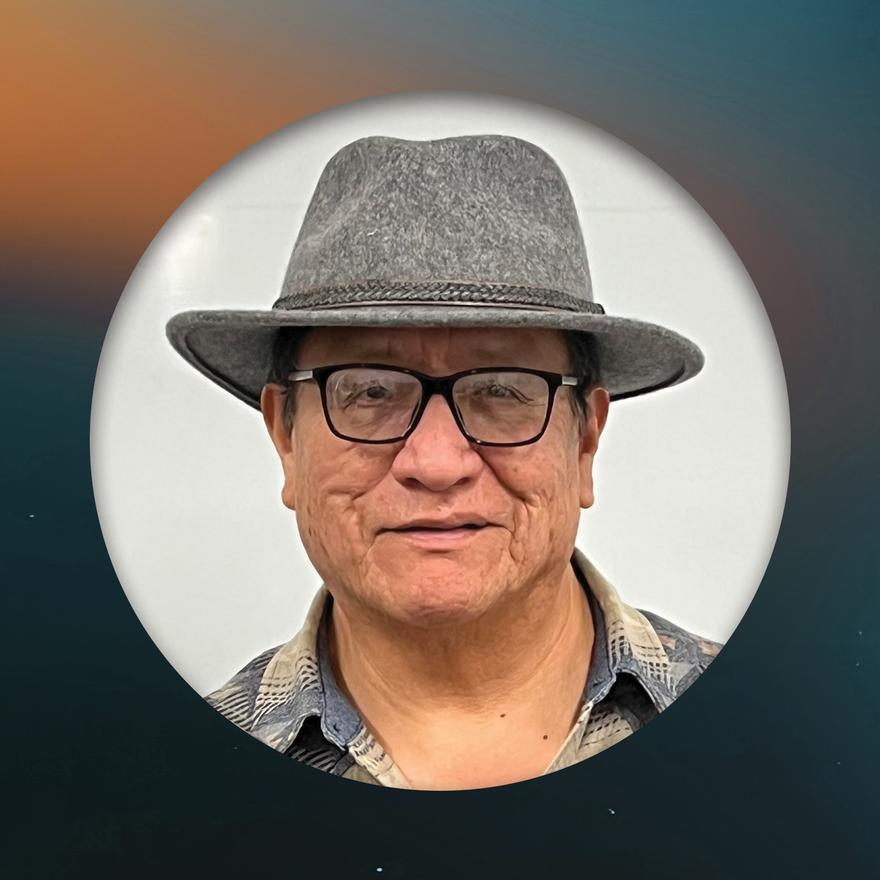
Approximately ten years ago, I returned home to the Pine Ridge Indian Reservation to native communities reeling from a rash of suicides. I remember wanting to help prevent future tragedies from occurring for our Oglala Lakota youth from a cloud of hopelessness that hung above them. After all, I, too, lost younger relatives to this seemingly senseless tragedy and had no readily available answers for them.
Late one night, I received an emergency phone call from my distraught daughter telling me of my only son's suicide completion. My world drastically changed overnight and I became lost without any direction. The pain of bereavement becomes tenfold when it occurs within your family circle. I sat alone immersed in bereavement and began writing therapeutic notes as a measure for healing myself. There was nothing more to do but fi nd a way for healing the pain in my heart. I attempted every idea for having my son walk through the front door to greet me once more.
This healing process began to slowly unravel as solutions began to unfold for me. First of all, it was returning back to a time when inner-strength was normal for our Oglala Lakota ancestors. Secondly, this healing journey took me back to my boyhood remembering my grandparents' stories. Thirdly, this was followed by our Lakota cultural healing practices for honoring life. Lastly, rediscovering our ancestors' way of life became a starting point for finding answers today. A light bulb came on for me!
The solutions lie in combining these four keys together and unlocking a set of locks that historically held our youth captive—and myself, included. Unknowingly, what
began as a healing journey became a labor of love and a tribute to my beautiful son, nephew, and the many others who took their journey in this tragic fashion.
It evolved into a spiritual undertaking to heal my spirit after experiencing such a loss in a tragic life-changing fashion. Unknowingly, throughout one's bereavement, it begins with healing a wounded spirit. The first step is finding peace. This needs to be attained as it allows finding answers for healing oneself.
After all, everything is connected, and so are suicides entangled in a network of historical, social, cultural, and political causes that need careful and truthful unraveling. What began as a focused attempt to understand and prevent the taking of one's own life evolved into a much broader analysis, mainly because we are taught to construct rather than dismantle our beliefs. For example, construction includes all the beliefs imported into this country that replaced our original instructions that play an underlying role for taking one's life. On the other hand, actualizing spiritual significance among our Indigenous people—most especially among our youth—has us carefully examine where spiritual significance became lost for us. It was a careful dismantling piece by piece to question even the smallest of pieces to see hopelessness as it developed in its true form for us.
A key factor in this equation is determining whether or not a person who commits suicide can be attributed, to some degree, to a loss of spiritual identity or spiritual significance. We have been taught over the course of time that our Lakota lifeways and language were wrong. This became a gigantic loss for a majority of people who have been colonized. Unfortunately, the loss of spiritual significance has become prevalent in the continental US as well.
Our ancestors strived to build a relationship in-sync with all life forever in constant motion. Their mental capacity included how they communicated to sustain these relationships built to acknowledge nature. As I re-educated myself, I learned my Oglala Lakota ancestors were truly knowledgeable beyond the word civilized. They were spiritually significant because their way of life was immersed in purity. From water, foods, to the air they breathed held no impurities to disrupt their cognitive development. If you are physically healthy free of toxicity, it influences the flow of your blood throughout your body to influence your mind. Your mind is able to see much more than the physical world we live in today. It sees the spirit of life in nature. It reveals the Circle of Life and the Web that connects us all together. They understood their time on this earth was limited and felt sacrifice for the good of the whole nation was life's purpose.
Lakota Wisdom
Further, all Indigenous people like the Oglala Lakota have been experiencing a loss of spiritual, emotional, mental, and physical significance ever since first contact with western "civilization." It brought war and violence, neglect and abuse, racism and rape, economic and social inequality, and the destruction of our living breathing world, which we honor and respect in our traditional culture.
All these destructive forces have since conspired together and been influencing our cognitive, emotional, physical, and spiritual development from birth to adulthood. As a result of living in this complex postmodern, industrial, capitalist society, members of our culture—some more, others less—suffer from complex maladaptation symptoms while few of us have clear guidelines and answers that could assist us in finding our way towards mental, emotional, physical, and spiritual health and strength.
The proponents of Western Civilization have always preferred to blame their victims and thus taught us to accept responsibility and guilt for our dismal situation rather than finding solutions and answers for paying the heavy price we have paid for the loss of our lands and way of life. To dismantle this belief we need to travel back in time to examine what causes were placed in our development and cultural evolution that give rise to the current symptoms and weigh their value. Thus, I will dismantle the dysfunctional false self we become under colonization and reconstruct our true indigenous self to be both self-determined and capable of facing modern life with a strong sense of self-worth and resilience.
This book became a personal labor of love because in my own journey of acquiring an education and gathering knowledge, wisdom, and intelligence—I learned these do not matter until they are given to others to build upon. The full development of the human being in all four dimensions of the physical, emotional, cognitive, and spiritual— is lacking in our modern, materialistic, and hyper-individualistic world. To progress, our society should once again honor and value principles that sustain life, rather than destroy it. It brought together both worlds to be dismantled and reconstructed to better understand people's behavior in relationship to their environment at many levels.
I first learned of historical trauma and the assimilation process' negative impact on our development while attending graduate school. The doctoral study of Psychology and participation in my own ceremonial lifestyle of my ancestors began to unfold a truth before me. It led to thoughts of influence and motivation we carry throughout our lifespan and the need for having appropriate mentorship throughout our childhood to actualize any form of humanity. It meant mixing the two worlds to fashion a lifestyle worthy of living in both worlds as humanly possible. I am illustrating my journey through quotes and stories to construct a conceptual framework of becoming indigenized with our natural world and also dismantle false beliefs and premises that prevent this from occurring today.
For example, the process of colonizing has been going on for hundreds of years to date, forcing us to distance ourselves from our true self, if not completely denying it. Also, it has heightened the distance from our culture, its values and beliefs, its guidelines which have sustained us for countless centuries, leaving us with nothing to feed our spirit. To survive in this dominant command and control, reward and punishment, accumulation culture, we need to please and act what is termed "a good and educated Indian." If not, we suffer punishment, discrimination, hardships and suffering to this day. If we as colonized peoples then journey through our lives without an identity, it becomes apparent as an identity crisis. Simply put, colonization willfully creates chaos, and tears at the fabric of our identity so that we become unable to function appropriately and completely with our environment. As a result, intentional or not, this places us indigenous people at a disadvantage when we want to participate at a level equal to the colonizer in any facet of their society.
The more I studied what was lost cognitively, emotionally, physically, and spiritually, it was clear there was a pattern in which loss and suffering were connected. For example, the Lakota term "Mitakuye Oyasin," translated "We are all related," implies creating a desire to learn about the connection and relatedness of all living beings, literally the world's entire ecological system that is and does sustain life on this planet. The intelligence and wisdom of our Oglala Lakota ancestors were evident from just this one concept, which is largely absent in mainstream modern culture, had depth far beyond what was written and recorded of them. It entailed a process of growth for both the storyteller and receiver of the story.
If we are to learn from our past, we must understand that dividing, conquering, and colonizing others needs to be dismissed as a failure of human potential and therefore be placed in the museum section of our collective minds. The colonizing strategy no longer works because we are aware of its implications and destruction of indigenous peoples, cultures, and societies around the world.
Whether it comes with privilege or not, the formation of how one thinks impacts how we deal with others. Western Psychology and Anthropology teach us how one's journey in the world is influenced in the very first steps by how our environment— i.e., the people close to us and those in power—views the world and transmits this worldview to us. The resulting hierarchical ranking and discrimination is a carefully planned strategy to place many at the bottom or even outside the peripheral of western society. If our world is to be saved we must discover new approaches and practices to dealing with each other that are compassionate towards each other and the natural world and only in that way become truly sustainable. For this, we need to rediscover what has worked in the past and apply this wisdom and knowledge to today's culture to transform it into a sustainable one that is worthwhile living in once more.
Dedication
This book is dedicated to those who left us to deal with the tragedy of suicide. To my beautiful son Anthony Ten Fingers and nephew Jerry Dreamer and all those who left us in this fashion. These acts alone have me learning beyond the curtain of transparency. For this, I am thankful you have both been a part of my life.

www.betterworldbooks.com/product/detail/lakota-wisdom-author-signededition-9781503062467
ABOUT TONY TEN FINGERS (WANBLI NATA'U)
My Oglala Lakota name is Wanbli Nata’u, Charging Eagle. However, my birth name is Javan Anthony Ten Fingers, commonly called Tony. I was born in the Drywood Community north of Oglala on the Pine Ridge Indian reservation. Early on, I developed a keen interest in our ancestors' understanding of time and place along with its transformative eff ects on our Indigenous physical, mental, emotional, and spiritual health. Initially, this would inform me of our mental and physical health issues resulting from an ensuing loss of relationship with our Earth with family, the animal world, and Spirit.
Order your 2026 Mystics Almanac now and gain the peace of mind to carry you through the entire year.
